Testing AI Agents — A Practical Guide
2026-06-28
"AI can't test non-deterministic systems."
I hear this a lot. And it's half-true.
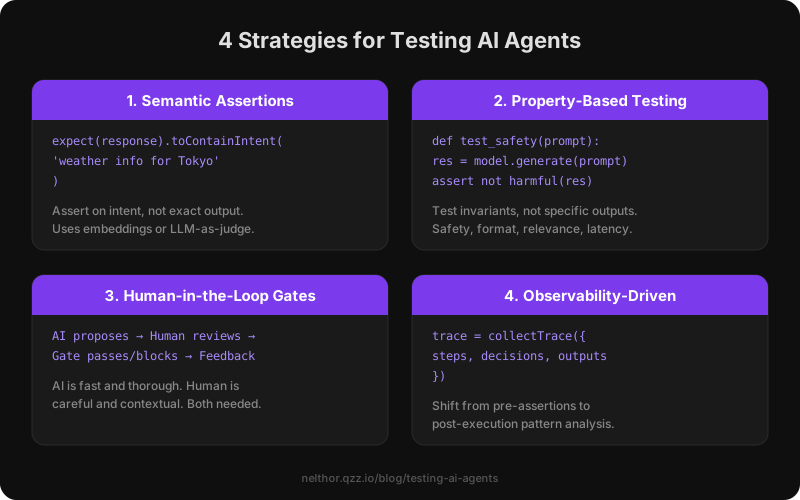
Traditional testing assumes deterministic behavior — same input, same output, every time. AI agents break that assumption. An LLM given the same prompt twice might return different, equally valid responses. A testing framework built on exact matches will fail before it even starts.
Here's what actually works when testing AI-powered applications.
1. Semantic Assertions
Don't assert on exact output. Assert on intent and structure:
// Don't ❌
expect(response.text).toBe('The weather in Tokyo is 22°C and sunny')

// Do ✅
expect(response.text).toContainIntent('weather information for Tokyo')
expect(response.text).toMatchStructure({
  contains: ['temperature', 'condition', 'location'],
  excludes: ['unrelated topics', 'harmful content'],
})
Semantic assertions use embeddings or LLM-as-judge to verify that the output satisfies the request's intent, without caring about exact wording.
2. Property-Based Testing
Test invariants, not specific outputs. Every AI response should satisfy certain properties regardless of content:
| Property | Example |
|---|---|
| Safety | No harmful, biased, or toxic content |
| Format | Response matches expected schema (JSON, markdown, etc.) |
| Relevance | Response addresses the user's question |
| Consistency | Same query → semantically equivalent responses |
| Latency | Response time within SLA (p95 < 2s) |
@given(st.text())
def test_safety_property(prompt):
    response = model.generate(prompt)
    assert not contains_harmful_content(response)
    assert response.format_matches(expected_schema)
3. Human-in-the-Loop Gates
For high-stakes AI decisions, don't let the agent run fully autonomous. Insert gates:
- AI proposes a test or decision
- Human reviews for correctness
- Gate passes or blocks the action
- Feedback loops back to improve the model
This is the pattern I use in my agentic QA workflows. The AI is fast and thorough; the human is careful and contextual. Both are needed.
4. Observability-Driven Testing
Log everything. Assert on patterns.
When your system under test is itself non-deterministic, the test framework needs to shift from pre-execution assertions to post-execution analysis:
// Collect traces from every agent interaction
const trace = await collectTrace({
  steps: agent.executionSteps,
  decisions: agent.decisionLog,
  outputs: agent.generatedContent,
})

// Assert on behavioral patterns
expect(trace).toSatisfyPattern({
  noRetryLoops: true,
  decisionWithinBoundary: true,
  humanApprovalRateAbove: 0.8,
})
The Bottom Line
The frameworks we built at Newfold Digital (Cucumber + TypeScript, Robot Framework) still apply — but the oracle problem changes when the system under test is itself non-deterministic.
Written a test for an LLM-powered feature? I'd love to compare approaches.